
Top drive — GO series
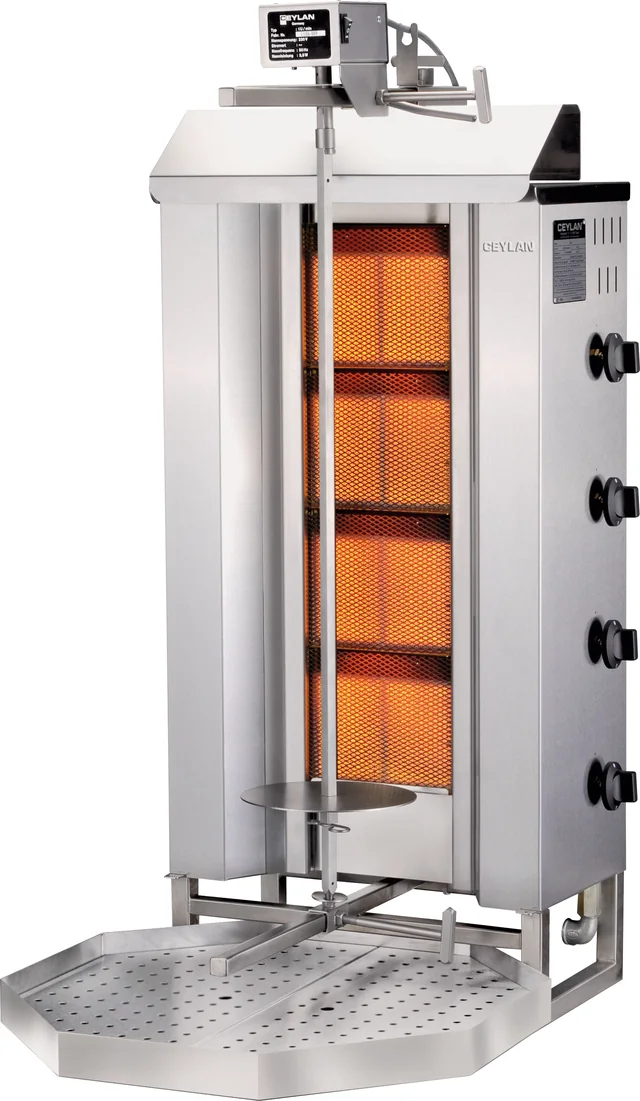
 DESIGNED & PRODUCED BY CEYLANESSEN · GERMANY
Bottom drive — GU series
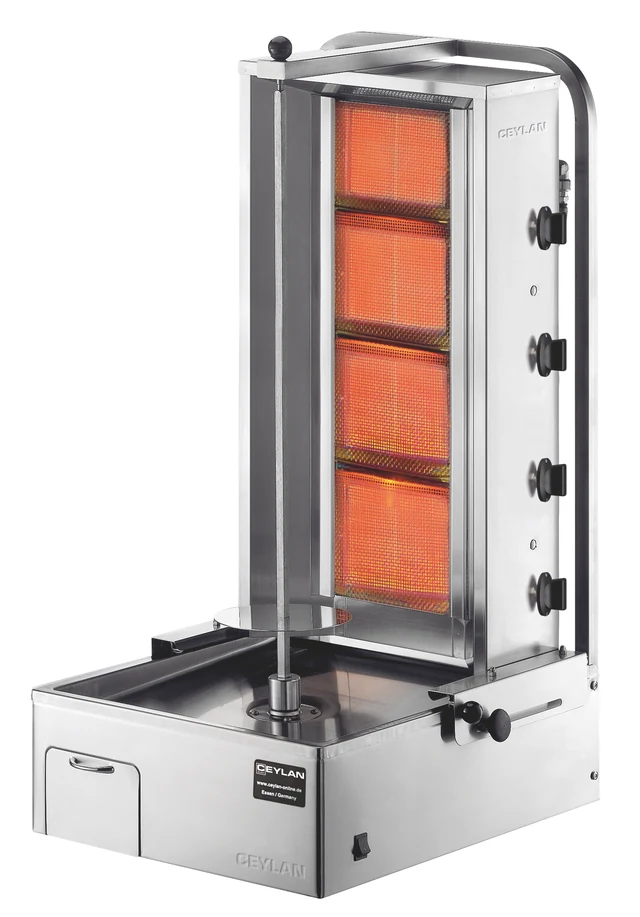
DESIGNED & PRODUCED BY CEYLANESSEN · GERMANY
Choose by design
The electric Döner grills of the CY series (glass ceramic, 400 V) have been discontinued; spare parts continue to be supplied where available. Find a spare part (opens ceylan-shop.de)
Gas Döner grills with top and bottom drive, twin systems and contact grills. The equipment is designed for long service life, even heat distribution and straightforward maintenance.
Contact grills
Contact grills complement the Döner line where flatbread, wraps and side dishes run through the same service point.
Gas or electric — what the decision depends on
Gas-fired grills reach high temperatures quickly and are independent of the electrical connected load on site. That is an advantage wherever the supply is limited or several devices run at the same time.
Electric grills can generally be controlled more finely and need no gas installation. In shopping centres, food courts and new tenancies this is often the point that dictates the decision — a gas installation there is either not permitted or only possible with considerable effort. Approval situation, extraction and existing infrastructure therefore decide as much as the technology.
Top drive or bottom drive
The GO series works with a top drive, the GU series with a bottom drive. Both cover the same capacity classes; the decision is made on site.
- Ceiling height
- The top drive builds upwards — the clear height above the device must allow the spit change.
- Spit change
- Where access from above is poor, the bottom drive has the advantage.
- Spit weight
- At high weight the bottom drive guides the spit more stably.
- Established practice
- A well-drilled team works faster with the familiar type.
Heat distribution across the spit height
What is decisive is not maximum output but evenness. If the heat drops in the upper third, cooking becomes uneven — the business then cuts either too early or too late. The grill technology is designed for even heat across the entire spit height; the gas devices work with 7–17.5 kW at 30–120 kg capacity.
Size for peak demand
What matters is not the average day but Friday evening. Twin systems with two spits allow parallel operation, separate varieties or switching on at peak time — without overloading a single spit.
Maintainability
Burners, motors, spits and grease trays are the parts that wear. They must be reachable without dismantling half the device. The construction is designed accordingly — which is why a grill remains economically repairable even after years.